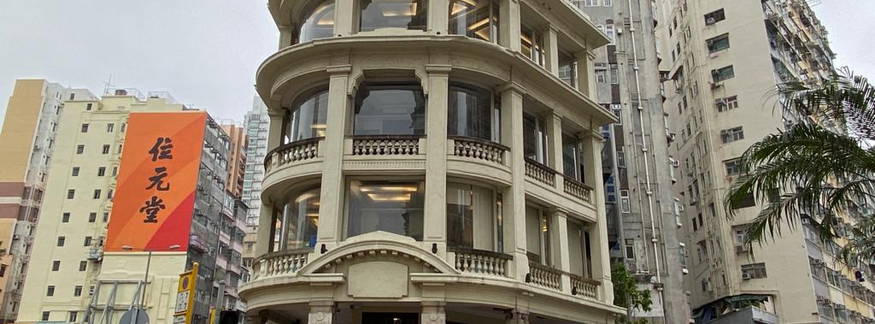
LUI SENG CHUN
Built by architect W.H. Bourne in 1931, this elegant corner tong-Lau shophouse was a former home to a bone-setting shop and the Lui family’s private residence. The architecture is typical of the fusion Chinese-Western style of the era, with deep verandahs that allowed for indoor-outdoor past days without air conditioning. The building managed to survive even as all of its nearby buildings were redeveloped. In 2012, it was activated and converted into a Chinese medicine center. There are an herbal tea shop and exhibition on the ground floor. 【How to go ?】🚇 MTR Prince Edward Station Exit C2【Revitalisation Scheme 】✨🏢Conversion of Lui Seng Chun into Hong Kong Baptist University Chinese Medicine and Healthcare Centre Lui Seng Chun was graded by the Antiques Advisory Board as a Grade 1 Historic Building in 2000. It is one of the buildings in the Revitalizing Historic Buildings through Partnership Scheme Batch 1 One under the Development Bureau in 2008. Hong Kong Baptist University (HKBU)submitted a conservation proposal of adaptive reuse of Lui Seng Chun as a Chinese Medicine and Healthcare Centre. An approval in-principle was given to HKBU by the Development Bureau in 2009.【Remiders】🔔 In order to reduce the risk of the spread of the novel coronavirus (COVID-19) in the community, the Centre has suspended ALL public guided tour services and reservations until further announcement on the website.Consultation hours (by appointment)Monday – Saturday:09:00 – 13:00;14:00 – 18:00Sunday: 09:00 – 13:00Public Holidays: ClosedGuided tour sessions (by appointment) Monday – Friday :14:30 & 16:00Saturday:09:30 & 11:00Online registration:http://scm.hkbu.edu.hk/lsctour【 Enquiries】 💻 📩 ☎️ADDRESS:119 Lai Chi Kok Road, Mong Kok, KowloonWEBSITE:scm.hkbu.edu.hk/lsc/en/index.htmlTEL:852 3411 0628FAX : 2381 8608
Chinese Public Dispensary
【How to go 】 MTR Sham Shui Po Exit A2 【Reminders】 Opening hours : Monday – Sunday :07:00 - 22:00 Not open to the public 【 Enquiries】 Adress: 137 Yee Kuk Street, Sham Shui Po, Kowloon
Sam Tai Tze & Pak Tai Temples
Two temples in one complex, Sam Tai Tsz Temple is a Grade II historic building originally built in 1898 by Hakka immigrants to honor their patron deity, Sam Tai Tsz, after a particularly deadly plague swept through Sham Shui Po. Full of fascinating details, the temple houses cultural relics that date back to the late Qing dynasty (1644-1911). After exploring this fascinating site, head next door to Pak Tai Temple – a Grade III historic building built by local fishermen in 1920 to honor the Emperor of the North, the eponymous Pak Tai【How to go 】 MTR Sham Shui Po Exit A2 【Reminders】 Opening hours : Monday – Sunday :08:00 - 17:00 【 Enquiries】 Adress: 196-198 Yu Chau Street, Sham Shui Po, Kowloon Free Admission
Sham Shui Po Park
Formerly the Sham Shui Po Barracks in the 1920s, this piece of land became the main POW camp during the Japanese Occupation of Hong Kong. There are two plaques erected in 1989 and 1991 to commemorate those who perished in the POW camp.【 Enquiries】 Address: 733 Lai Chi Kok Road, Sham Shui Po, Kowloon• Free Admission
Lei Cheng Uk Han Tomb Museum
In 1955, the Lei Cheng Uk Han Tomb was discovered when the government was building the resettlement buildings. It is believed that the tomb was built in the Eastern Han dynasty (AD 25 - 220). In 1988, it was declared as a gazetted monument. However, it is closed to the public for conservation reasons. Visitors can only have a glimpse of the interior of the tomb through the glass panel at the entrance passage. There is an exhibition hall next to the tomb, which displays pottery and bronze wares excavated from the tomb. Moreover, there is an exhibition inside the hall. Texts, graphics, photos, maps, videos and models are used to introduce the geographical situation, discovery and structure of the tomb.【 Enquiries】 💻 📩 ☎️Address : 41 Tonkin Street, Sham Shui Po, Kowloon•Tel. No. : 2386 2863•Fax. No. : 2361 2105Opening Hours: Monday to Wednesday, Friday to Sunday: 10am - 6pmChristmas Eve and Chinese New Year's Eve: 10am - 5pmClosing Days: Closed on Thursdays (except public holidays),and the first two days of the Chinese New Year• Free Admission【Remiders】🔔 In order to reduce the risk of the spread of the novel coronavirus (COVID-19) in the community, the exhibition hall has closeduntil further announcement.
Heritage of Mei Ho House
The Mei Ho House marked the beginning of the Hong Kong government's public housing scheme and was one of the first eight public housing projects built by the colonial government in 1954 for Shek Kip Mei Village. The reason for constructing the Mei Ho House was due to a fire accident in 1953. After World War II, a large number of immigrants from mainland China escaped to Hong Kong and the Shek Kip Mei squatter area become one of their settlements. In 1953, A disastrous fire struck on 25th December 1953 and almost 58,000 people lost their homes. In order to resettle these immigrants, the colonial government built a house called "Bowring Bungalows" as a temporary shelter for the fire victims, while Mei Ho House is one of these eight detached buildings. Due to the redevelopment plan, other buildings were demolished one after another, leaving only the Mei Ho Building as the only Mark I H-shaped resettlement block that remained in Hong Kong. Therefore, the government designated it as a Grade II Historic Building in 2005. Other than being converted into a popular youth hostel with backpackers, the current Mei Ho House has also opened "the Heritage of Mei Ho House museum". The museum recreated the living scenes of old Hong Kong, such as residential units and grocery stores, as well as providing guide tours for groups and the public. These services allow people to understand the grassroots living in the public housing estates from the 1950s to the 1970s.Due to the impact of the covid-19 epidemic, the Heritage of Mei Ho House museum is temporarily closed except for hotel room reservations.