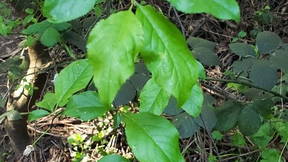
Red Alder Tree
You might notice here a small alder tree (Alnus rubra) growing close to the trail. Alders are used in ecological restoration since their nitrogen-fixing bacteria improve soil quality. Their roots sometimes wrap around each other before plunging into the creek where aquatic life can thrive. The Ohlone used the tree’s catkins to make protein-rich cakes. They used alder bark to make medicine to treat headaches, stomach cramps, colds, congestion, mouth sores, and for pain relief. They also made dyes from red alder in shades of red, brown, orange, and yellow used for dyeing canoes, baskets, and other objects.
California Towhees
Keep an eye out here for tiny, brown songbirds fluttering in the low branches. Well camouflaged, California towhees (Melozone crissalis) forage, nest, and sing in the shrubbery. Their even brown color boasts a splash of rust along their tail and around their beak. Towhees have the same short, rounded wings and thick seed-cracking beaks as sparrows but are larger and bulkier. Listen for their cheerful, chirpy trill while you watch them feast on wild seeds and the many local insects. Keep your distance in the spring since they’re very protective of their nests, sometimes even physically attacking intruders!
Valley Oak
One of the largest oaks in North America, the valley oak (Quercus lobata) is a common deciduous tree found throughout the East Bay and often seen in residential areas. This area was once a vast oak woodland, inhabited by the Ohlone people for thousands of years. Eventually, the oaks are what Oakland was named for. The valley oak’s acorns were a significant food source for the Ohlone, and the tree itself is still an integral part of California’s ecology. It helps sequester carbon and serves as an air and water pollutant cleanser by absorbing fertilizer and pesticide chemicals.
Joaquin Miller Park
Owned and operated by the city of Oakland, Joaquin Miller Park is a large open space named for California writer and poet, Joaquin Miller. Miller bought the land in the late 1800s, and lived here at the Joaquin Miller house (which has since been preserved). In addition to building a home, Miller planted hundreds of trees and placed monuments dedicated to his various heroes, including Moses, John C. Fremont, Robert Browning, and Elizabeth Barrett Browning where they still stand to this day.
Ohlone People
Sausal Creek may have been a transitional zone between Huichin and Jalquin Ohlone tribelets. Regardless, whichever group had villages up and down the creek, transitioning from one to the other dependent on season and what foods were abundant in which area of the watershed. They traveled by foot and by tule boats between the bay and the hills.
Old Pipe
Defunct pipes such as this one appear at several points along the Palo Seco trail. They were built to assist with excess water runoff, but because of natural changes in the landscape such as vegetation loss and erosion, these pipes were no longer able to perform their intended purposes. Ironically, despite being out of service, these pipes help keep the trail clear of dirt and overgrown vegetation.
Coast Redwood
Look up! The coast redwood (Sequoia sempervirens), aka the tallest living thing in the world is standing just above your head! A long-living evergreen, coast redwoods regenerate through seeds, with their seeds and pollen being located on the same tree, just on different branches. They are found between sea-level and 3,000 ft elevation, typically in humid regions along the Pacific Ocean. In the Bay Area, Oakland’s Reinhardt Redwood Regional Park is a great place to view these majestic trees without large crowds.
Western Sword Fern
The Western sword fern (Polystichum munitum) is a common and well-known evergreen fern native to this area. Sword ferns are found in the wild and in gardens, growing most abundantly in undisturbed, old-growth forests. Western sword ferns are used for prevention of hillside erosion and soil compaction. The Ohlone used these ferns as lining in a cooking pit, between stacking objects, covering floors and beds, and as food. It was also part of a traditional game known as pala-pala, as well as used in rituals.
Vivid Dancer
Flashing across streams in electric blue bursts, vivid dancers (Argia vivida) can be found hanging around spring-fed streams in arid/semi-arid regions, feasting on a wide variety of aquatic insects. These small damselflies boast bright blue coloring and a dark stripe across their upper thorax. While they may look innocent, these bright bugs will munch on everything from mayfly larvae to full-grown mosquitos, so you can thank them for saving you from a few extra bug bites while you’re out in nature!
Annaphila Diva
Annaphila diva is a little day-flying moth that flies in the spring. It has short and wide wings, black forewings with a white C-shape spot, and pale yellow and black hindwings. It is found in the western part of Pacific Northwest near creeks and rivers. The larva is a food-plant specialist feeding on miner's lettuce (Montia perfoliata). Unlike many moth species, the adults are day-time active, visiting flowers during the day.
Wilson's Warbler
Wilson’s Warbler (Cardellina pusilla) is a small, yellow and green bird native to North America. The SF Bay Area is part of the Wilson’s Warbler’s winter range, and the Pacific coast populations even have the brightest foreheads and faces. Keep an eye on the trees in the springtime -- these birds have little fear of humans and often begin nesting in early March. Otherwise, you can often find them feeding on insects or foraging through shrubs.
Logging
In 1820, the Spanish government granted this land, including Dimond Canyon, to Luis Maria Peralta. About ten years later, the San Antonio area of the canyon became part of his son Antonio Maria Peralta's share. The hills were thick with redwoods, and in 1841 the first two lumbermen began cutting and selling timber from San Antonio.
Around this time the Palo Seco Mill was built. It may have stood near today's Joaquin Miller Court, uphill from Mountain Boulevard, but no one knows its exact location. In 1849, lumber tycoon Henry Meiggs bought the mill and sent his "lumbermen army" into the woods later that year.
Logging spread quickly, some of it legal and some of it trespassing on Peralta land. Farther east, in what is now Redwood Regional Park, brothers Thomas and William Prince ran at least five mills, mostly around today's Stream Trail and Tres Sendas Trail. They got the land through a school warrant system. When lumber prices soared in 1852 as San Francisco grew, they built the Prince Mill, and by 1856 the area's continuous redwood forest was nearly gone.
The millers also built the roads. Ox-cart tracks and skid roads ran through Dimond Canyon up to the Palo Seco Mill from about where Park Boulevard and 13th Avenue are today. In 1852, Contra Costa County built a road from the Prince Mill to Castro Valley, and four years later roads from other mills joined it.
Park Boulevard itself began as a logging road for the Palo Seco Mill. In 1867, Hugh Dimond, who made his fortune in the Gold Rush, bought the canyon below, and it has been called Dimond Canyon ever since.
Milkmaids
When the pink and white petals of milkmaid flowers (Cardamine californica) begin to unfurl, spring in the Bay is on the horizon! Milkmaids are a flowering plant of the Brassicaceae family, and are typically one of the first flowers to bloom in the Bay Area, sometime between January and May. These small plants usually reach a height of just under two feet, with their flowers only growing as big as half an inch in diameter. When it rains, milkmaids actually close their petals to protect their pollen from being washed away.
Friends of Joaquin Miller Park
It takes much more than you think to maintain this wonderful park. Friends of Joaquin Miller Park (FOJMP) is a group of hikers, mountain bikers, equestrians, dog owners, cross country runners, historians, writers, and neighbors, who dedicate themselves to maintaining and enhancing the natural legacy of this area. They follow the footsteps of the Lisjan Ohlone people, the Native Americans who have resided in this area for centuries, as well as the late 19th Century poet and environmentalist Joaquin Miller, in whose memory the park is named. If you ever enjoyed this park and wanted to help out, they are always happy to accept any volunteer!
Gnomes!
Here a gnome sits atop a tree along the Palo Seco trail of Sausal Creek. Visitors to the trail can spot several gnomes perched amidst the foliage. Back in 2013, thousands of painted gnomes began popping up all over Oakland's telephone poles and traffic light controllers, becoming a local trope. The origins of these gnomes are unknown, but they add a bit of delight to this creekside walk.
Button's Banana Slug
Deep in the Bay Area’s wet forests, banana slugs (Ariolimax buttoni) can be found feeding on decomposed plant and animal matter. These spineless, single-lunged gastropods are considered one of the world’s slowest organisms, with a top pace of about 6.5 inches per minute. Interestingly, banana slugs have been known to exhibit mutually symbiotic relationships with redwood trees. Rather than feeding on the tree’s seedlings, banana slugs consume plants that redwoods compete with for light, water, and nutrients. In response, redwoods award the slugs with their desired cold and wet environments.
Retaining Wall
Looking north along this hillside, we can see a small crib retaining wall, consisting of interlocking wooden boxes filled with granular material which allow free drainage. Building on steep slopes can encourage erosion, so retaining walls like this one are constructed in order to prevent hillside disintegration and protect hilltop streets from collapsing. While it may not look like much, this retaining wall is truly an important feat of engineering working to keep hillsides, roads, and homes safe from harm.
More Gnomes!
Another step, another gnome. This gnome has made their home on top of a tree stump.
Sinawik Cabin
Just ahead, you’ll find the remains of Sinawik Cabin. Once a Girl Scout meeting place in the 1940s-1980s, all that’s left of the cabin now is its ruined foundation. In 2011, the Friends of Joaquin Miller Park asked the Oakland City Council to fund the cabin’s removal, as they believed it posed a threat to public safety and was a burden to maintain. However, the cabin burned down on July 4th, 2013 before the city could remove it.
Human Conservation Effort
Pictured here are two man-made signs saying, “Protect the land. Don’t cut through” and “No bike area.” These are the result of efforts by citizens to help preserve the trail and natural habitat. Taking frequent shortcuts between switchbacks has a detrimental impact on the land, causing vegetation loss, hillside erosion, and land degradation. This erosion can lead to increased pollution and sediment in waterways, harming fish and other species that rely on the water. Switchback trails were created to prevent this from happening, keeping the land healthy and the trails stable!
Common Douglas Fir
Douglas fir trees (Pseudotsuga menziesii) are native to western North America, but derive their familiar name from the Scottish botanist, David Douglas. The coastal variety is fast growing and long-lived, reaching over 300' tall and 500 years of age, with some over 1,300 years old. They are well adapted to fire management, as they shed their lower limbs when they grow. The tree’s seeds are an important food source for small mammals like squirrels. They also provide a rich source of vitamin C, and were likely used by the Ohlone for medicinal purposes. Douglas fir is the country's top source of lumber today, and played a significant role in building structures in the American West, since the mid-1800s. Almost half the Christmas trees grown in this country are Douglas fir.
Sharp-tailed Snake
With a pointed tail tip and hiding skills, the sharp-tailed snake (Contia tenuis)is an expert at avoiding its predators. Often found in the Bay Area, it is secretive, spending most of its life hidden away from human sight. These little snakes live in a range of environments across the Western U.S., but they most prefer damp areas with lots of surface material like twigs, roots, and leaves. They feed almost exclusively on slugs, and are most active in the fall and winter. Most sightings occur when digging in gardens or construction sites, where they curl up into a ball as a protective measure.
Industrial Sewage Pipe Diversion
Culvert pipes like this one keep the creek flowing despite impediments, such as pathways or roads. Culverts decrease erosion around the stream-pathway intersection while gravity keeps the flow of the water moving. Its galvanized metal is also able to hold up in environmentally tough conditions, allowing it to stand the test of time and keep our waters in motion!
American Robin
Did you know the American robin (Turdus migratorius) is one of the 50 most common birds in the Bay Area? With a brick-red breast, gray head and wings, and a bright yellow bill, robins can be seen across the Bay year-round. Robins are very territorial, often aggressively defending their nests, making loud alarm calls to distract predators, and even dive-bombing humans that get too close, so be sure to keep your distance!
Western Harvest Mouse
The western harvest mouse (Reithrodontomys megalotis) is one of the smallest rodent species in this area. They are primarily nocturnal, most active before midnight, on moonless or overcast nights. Found mostly in shrub lands and grasslands, their nests are about the size and shape of a baseball, consisting of grass lined with fine plant material. These nests are located on the ground in clumps of grass, shrubs, or logs, or hanging from vegetation. Each nest has a small entrance on its underside leading to a golf ball sized chamber lined with dandelion fluff or a similar material. Western harvest mice mostly eat seeds, leaves, and stems of grasses and other plants, occasionally eating insects, like grasshoppers, crickets, and beetles.
Variable Checkerspot
Checkerspot butterflies (Euphydryas chalcedona) feature orange, white, and black "checkered" wings. Common around the west coast of California, in the Coast Range and the Sierra foothills, checkerspot larvae vary in color at different locations. Most caterpillars in this area are black with orange markings. They eat a mix of plant leaves. Adult checkerspot butterflies visit many flowers, including the native California Buckeye, Squawbush (Skunkbush, Lemonade Berry), Yerba Santa, and thistles.
Giant Wakerobin
The beautiful giant wakerobin (Trillium chloropetalum) is a perennial plant native to California, usually found thriving among redwood or other forests. It grows locally, as well as throughout the coastal ranges of California and the Sierra Nevada foothills. The plant tends to form in clumps under shaded areas while the leaves grow in whorls of three, hence the name trillium. When it flowers in the spring, its egg-shaped petals range in color from dark red to white and emit a rose-like scent. Don’t let that lure you in though - it is highly toxic!
"The Hights"
The Hights [sic] was the 52-acre estate of Joaquin Miller, and is now part of Joaquin Miller Park.
The land was purchased by Oakland in 1919 to become a new city park. That was later merged with Sequoia Park to become the Joaquin Miller Park of today.
In addition to planting thousands of cypress, pine, and eucalyptus trees, Joaquin Miller built a number of monuments/follies, and several structures. Most of the structures except the Abbey are gone.
For a time there was a small pond near the Abbey and a seasonal creek. The creek is remembered with a small bridge near the restored Abbey. Note that the original county road followed a slightly different route up the hillside; the Abbey was not as close to the road as it is now to Joaquin Miller Road.
Pale Beauty
Pale Beauty (Campaea perlata) is a nocturnal moth of very light pale green. The adult can be found in woods and woodlands, both wild and developed, where host trees exist. Females, who are usually larger than males, lay a clutch of round, yellow eggs that become red over a few days. Larvae look like twigs and branches. These caterpillars eat leaves of deciduous trees such as oak, elm, and willow.